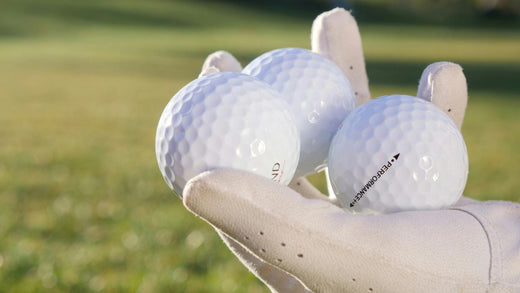
The choice of golf ball must be suited to your level of play. Several criteria should be considered based on your handicap index: spin, flight behaviour, speed, distance and wind resistance.
Balls designed for beginners compensate for certain shortcomings, such as a less powerful swing, while balls equipped with advanced technologies offer superior control.
Here is our selection of the 3 best balls for each of the 4 main index brackets, with the real budget to expect, both new and Golfiller refurbished.
| Your index | Recommended featured ball | Compression | Golfiller monthly budget |
|---|---|---|---|
| 36+ (beginner) | Inesis Soft 500 | 50 | 12-16 € |
| 18-28 (average player) | Srixon AD333 | 73 | 12-18 € |
| 10-18 (confirmed player) | Titleist AVX | 85 | 18-30 € |
| < 10 (single-digit) | Titleist Pro V1 | 87 | 25-35 € |
Understanding your index before choosing your ball
The index is the figure that summarises your level of play. Calculated by the French Golf Federation based on your latest qualifying rounds, it ranges from 54 (maximum beginner) to 0 (scratch player). The lower it is, the better you are.
Why does your index determine the choice of ball? Because it is directly correlated to your swing speed, which determines three things:
- The ideal compression of the ball (how much it deforms on impact)
- The recommended construction (2 layers for distance, 3-4 layers for control)
- The smart budget to spend on a ball you will sometimes lose
If you do not yet know your index, start from your usual score over 18 holes: 110+ places you in the 36+ bracket, 95-110 in the 18-28, 80-95 in the 10-18, and below 80 in the single-digit bracket.
Index 36+: absolute beginner
Your profile
You are discovering golf, your swing is not yet consistent, you lose 4 to 8 balls per round. Your driver swing speed is around 110-130 km/h. Your priorities: not blowing the budget on lost balls, feeling the ball on the putting green, and keeping a straight shot without too much unwanted spin.
What you need technically
- Low compression (50-70): the ball compresses at your swing speed
- 2-layer construction: simple, durable, forgiving
- Surlyn cover: resists off-centre iron strikes
- Reasonable price: losing a ball at €4 hurts less than at €1
Our top 3
Inesis Soft 500
Designed specifically for beginners by Decathlon. Compression 50, surlyn, ultra-forgiving. The best value for money on the market in this profile.
Wilson Duo Soft
Compression 35, the lowest on the market. A reassuring "soft" feel on the putting green, high trajectory, contained budget. An excellent choice for golfers with sensitive hands.
Callaway Supersoft
Compression 38, accessible premium brand. More expensive than the other two but a progressive step up: you can keep the same ball as you improve towards index 28.
Index 18-28: average / occasional player
Your profile
You are the most common type of golfer in France. You play regularly (1 to 3 times per month), your swing is consistent but you still lose 2 to 4 balls per round. Your swing speed is around 130-150 km/h. Your priorities: some feel without paying the price of a pro ball, distance to reach the green in 2 on par 5s, and a controlled annual budget.
What you need technically
- Medium compression (70-85): balance of distance and feel
- 3-layer construction: some feel without excessive extra cost
- Mixed cover: ionomer or urethane depending on budget
- Recognised brand: you can identify your ball by sight on the course
Our top 3
Srixon AD333
The absolute reference in this bracket for 15 years. Compression 73, 2 progressive layers. Plays above its price bracket. A firm favourite among our community of index 20-25 golfers.
Titleist Tour Soft
Compression 65, premium "soft" feel, Alignment Integrated Marking to improve putting. A step above for those moving towards index 15.
TaylorMade Tour Response
Compression 70, 3-layer construction, urethane cover. Distance and high trajectory for swings of 130-150 km/h. The best TaylorMade compromise in this bracket.
Index 10-18: regular confirmed player
Your profile
You play 4 to 8 times per month, your swing is consistent, you lose 1 to 2 balls per round. Swing speed 145-165 km/h. You are starting to notice the differences between balls: wedge spin, putting behaviour, sound at impact. Your priorities: performance on played shots (approach, putting), preserved distance, and a budget that justifies the quality.
What you need technically
- High compression (80-95): your swing compresses the ball sufficiently
- 3-4 layer construction: feel and spin control
- Urethane cover: spin on wedges and stopping on the green
- An "identity" ball: you stick with the same model season after season
Our top 3
Titleist AVX
Compression 85, urethane, penetrating trajectory. The Titleist "best compromise": premium feel without the Pro V1 cost. Ideal for golfers with index 12-16 seeking performance without the entry-level price tag.
Callaway Chrome Soft
Compression 75, Triple Track alignment technology, TPU urethane. Very soft at impact, ideal for confirmed players with a slow tempo. The "softest" of the premium balls.
Srixon Z-Star
Compression 90, 3-layer urethane. Excellent feel/price ratio in this bracket. Preferred by golfers with a fast swing who want wedge control without sacrificing driver distance.
Index < 10: single-digit / competitor
Your profile
You are "single-digit" (single-figure index). You play 8 to 15 times per month, you score around par, you compete at club or inter-club level. Swing speed 165-180 km/h and above. You lose fewer than 1 ball per round. Your priorities: maximum performance on every shot, absolute loyalty to ONE model (for consistency on the putting green and around the green), premium feel.
What you need technically
- High compression (95-105): your swing speed exploits the ball
- 4-layer construction: fine spin management depending on the club
- Thin urethane cover: maximum spin at the wedge, trajectory control with the driver
- Consistent production: ball 12 from the sleeve must play like ball 1
Our top 3
Titleist Pro V1
The world reference. Compression 87, 3 layers, urethane. Penetrating trajectory, controlled spin, reference feel against which all other premium balls on the market are measured.
Titleist Pro V1x
Compression 102, 4 layers. Higher trajectory than the Pro V1, more iron spin. For very fast swings (170 km/h+) looking to naturally launch the ball higher.
TaylorMade TP5 / TP5x
Compression 83 (TP5) or 97 (TP5x), 5 layers. A credible alternative to the Pro V1 with a slightly softer feel. The TP5x for swings> 170 km/h.
Summary table: ball + budget by index
| Index | Featured ball | Compression | Budget /month Golfiller | Budget /month new | Saving /year |
|---|---|---|---|---|---|
| 36+ | Inesis Soft 500 | 50 | 12-16 € | 30-50 € | ~250 € |
| 18-28 | Srixon AD333 | 73 | 12-18 € | 30-60 € | ~350 € |
| 10-18 | Titleist AVX | 85 | 18-30 € | 50-90 € | ~500 € |
| < 10 | Titleist Pro V1 | 87 | 25-35 € | 65-90 € | ~600 € |
Budgets calculated over an 8-month golf season (March to October) in France, based on average consumption per profile. Golfiller prices are indicative: see each product page for the current rate.
Special case: seniors and slow swing
The index does not tell the whole story. A senior golfer with index 15 and a swing speed of 130 km/h does not have the same needs as a 35-year-old golfer with the same index at 160 km/h. For seniors and all golfers with a slow swing (below 140 km/h), the rule is simple: drop down one compression category.
- Senior index < 10: favour the Pro V1 (compression 87) over the Pro V1x (102) — your speed will not exploit the V1x
- Senior index 10-18: the Callaway Chrome Soft (75) rather than the Z-Star (90)
- Senior index 18-28: the Titleist Tour Soft (65) or Inesis Soft 500 (50) rather than the AD333 (73)
- Senior index 36+: Wilson Duo Soft (35), the lowest compression on the market
To go further on compression, consult our compression comparison table for all balls on the market.
Frequently asked questions
How do I find out my index if I am just starting out?
If you are registered with the FFGolf, your index is calculated automatically after your first 5 qualifying rounds. If you are not registered, start from 54 (maximum beginner index) and use our index calculator to estimate your current level.
Does a refurbished ball really play like a new one?
For Grade A (near-new) balls, yes: these are balls recovered on the course that have sometimes only been used once. Aerodynamics, compression and cover are identical to new. Only the cosmetics may show very slight marks. For Grades B and C, performance remains excellent for practice and recreational play.
Should you change ball when your index drops?
Not straight away. A good "progressive" ball such as the Callaway Supersoft, the Srixon AD333 or the Titleist Tour Soft will accompany you from index 28 to index 15. It is only when you drop below index 12 that the difference with a premium urethane ball becomes noticeable, mainly at the wedge.
Why does ball compression matter so much?
Compression measures how much the ball deforms on impact. If your swing is too slow to compress the ball, you lose distance and feel. If your swing is too fast for the ball, you lose control. The higher your index, the lower your swing speed generally is, and therefore the lower the compression should be.
How many balls to buy at once?
For a beginner: a pack of 50 balls covers an entire season. For an index 18-28: 30 to 50 balls per season. For a regular player: 25 balls of the same model is enough (you lose fewer). Packs are always better value than buying individually at Golfiller.
Conclusion
The rule to remember: your ball must adapt to your swing, not the other way around. And your budget must adapt to your actual ball consumption, not the recommended retail price.
On Golfiller, you will find all 12 balls mentioned in this article in refurbished condition at -30% to -70% of the new price, delivered in 3 to 5 days.
View all our golf ball packs
Note: These recommendations are indicative. It is essential to try different balls to determine which one best suits your playing style and personal preferences.